

“Business video services” is the phrase most production companies put on their website, and it tells a buyer almost nothing. It covers a thirty-second commercial and a library of safety training videos. It covers a brand film and a day of product photography for a launch. The cost of all that runs from a few thousand dollars to well past a quarter of a million.
So this post breaks it down the way a marketing team actually buys it. What the main types of business video are, what each one includes, what they typically cost, and how to work out which one you need before you call anyone.
What counts as business video services?
Business video services are the production of video a company uses to sell, explain, recruit or train. In practice that is six kinds of work: brand films, commercials and CTV spots, product and launch videos, explainers and animation, training and internal video, and recruitment and culture pieces.
Most production companies make all six, and the camera is the same for every one of them. What changes between them is how much creative development the piece needs, how many shoot days it takes, and how many places the finished video has to live. Those three things decide the cost far more than the format does.
A growing share of these projects include photography as well. When a crew is already on set for a product video, shooting the stills the same day costs far less than booking a second shoot later. That is why our stills work is usually scoped alongside a motion shoot rather than on its own.
The main types, and what each one includes
Brand film. One to three minutes on who the company is and why it matters. Concept, script, interviews or talent, often several locations, then a full edit with music, colour and sound. Usually the most creative development of anything on this list.
Commercial or CTV spot. A :15, :30 or :60 made to run as paid media. Tight scripting, casting, often a studio or location build, and the licensing that lets it air. Our What If? spot for Carnegie Mellon debuted at the 2023 Tony Awards, which is about as public as a :30 gets.
Product and launch video. The product doing its job, clearly. Often studio-based, and often paired with stills and short social cutdowns from the same shoot.
Explainer and animation. For the thing you cannot film: software, a process, a mechanism inside a sealed box. 2D, 3D or motion graphics, depending on what has to be shown. If you are weighing it against live action, we compare the two in live action vs animation.
Training and internal video. Safety, onboarding, process. Lower polish per minute, higher volume, and the value is clarity and consistency. We cover what good looks like in safety training video production.
Recruitment and culture. Real people on camera in real places. Mostly interviews and documentary-style coverage, built to make someone want the job.
What does business video cost?
Most of the live-action motion work we produce lands between $50,000 and $125,000. Animation starts around $15,000 and scales past $100,000 depending on style, length and complexity. Standalone photography runs $15,000 to $40,000. Larger campaigns, with expanded creative development, several shoot days, locations, talent and a broad set of deliverables, can go past $250,000.
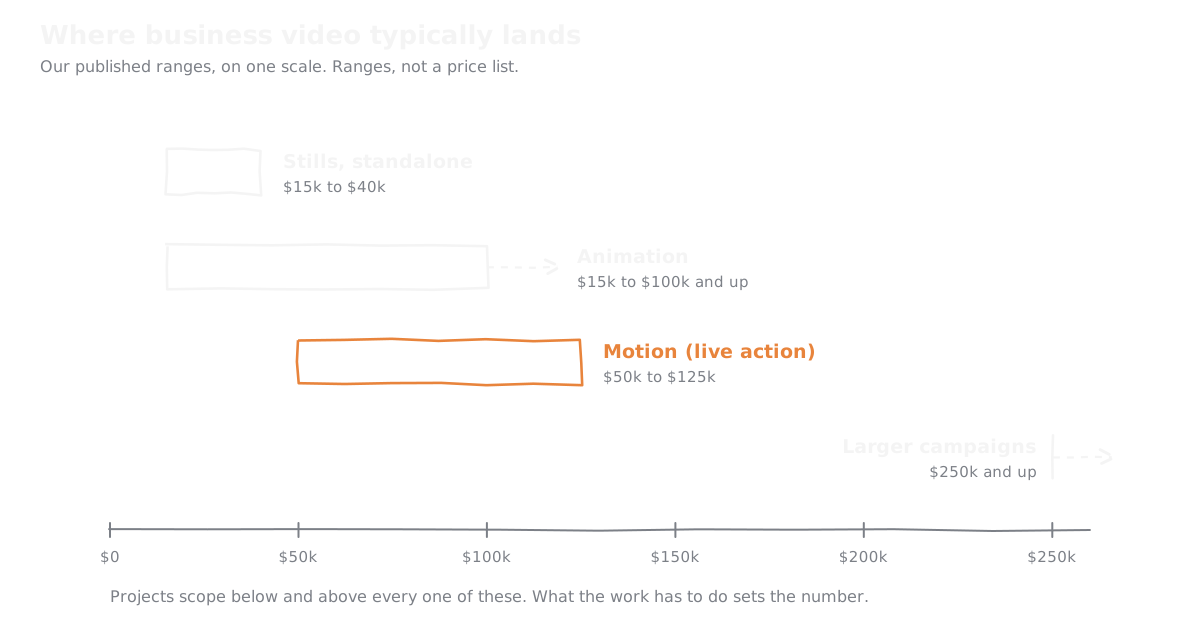
Read those as ranges, not a price list, because there is no price list. Plenty of projects come in under them and plenty go well over. A focused training series or a single product video can sit comfortably below the motion range, and leaner structures exist for ongoing work. The right number depends on what the video has to do, not on which box it fits in.
What moves a project around inside its range is predictable. More creative development, more shoot days, more locations, more talent, more finished versions. Licensing is the one people underestimate. Putting a person’s face in paid media for years rather than months can cost several times what you paid for their day on set, which is why talent buyouts deserve a decision early rather than a surprise late.
What is actually inside a production budget?
Every live-action project splits into three phases, plus licensing.
Pre-production is concept, script, casting, locations, scheduling and the plan for the day. It is the cheapest phase to change your mind in and the most expensive one to skip. We walk through it step by step in what actually happens in pre-production.
Production is the shoot itself: crew, camera and lighting, the studio or location, talent, and everything it takes to run the day safely. This is where most of the money goes on a live-action job, and it is priced by the day, so the number of shoot days is the single biggest lever in the budget.

Post-production is the edit, colour, sound, music, graphics and every version you need delivered. Versions are where shooting once pays off. A :30, a :15, three vertical cutdowns and a captioned set all come from the same footage. Each one takes edit time, but none of them needs another shoot day. A plan that captures everything in one go and cuts it many ways is the most efficient thing a production budget can do.
What business video services do not include
Worth saying plainly, because it catches people out. A production company makes the asset. Most do not buy the media, run the ads or manage the campaign, and we do not either. We create the work that makes a campaign worth running.
So if a commercial is meant to air, budget the placement separately. A finished :30 with no media spend behind it is a very well made file. The same goes for internal video: someone on your side needs to own where it lives and who is told to watch it. None of that is complicated, but it has to be somebody’s job before the shoot, not after.
How to work out which one you need
Start from the job, not the format. Who is watching, where are they watching, and what should they do when it ends? A buyer on a product page needs a different video from a candidate on a careers page, even if both run ninety seconds.
Then decide whether this is one project or an ongoing need. A launch is a project. A steady flow of product, social and internal content is a programme, and it is usually cheaper and better run as one. We explain why in the benefits of long-term partnerships, and Spark Sessions is how we run that kind of standing arrangement.
Last, put a number on it before the first call. Not a perfect number. A range, or even just the point where it stops being worth it. How to set a video budget before you have a concept walks through it, and our budget worksheet takes about ten minutes. Nothing you enter is sent anywhere.
Why the budget question comes first
We ask about budget on the first call, and people sometimes hear that as a sales move. It is the opposite. The budget decides the creative, the crew, the schedule and the scope. Without it, we would be guessing, and so would you.
With a number on the table, even a ceiling, we can tell you on that first call what it buys, which of the types above it fits, and where it would stretch further. That is a far better use of everyone’s time than a proposal built on a guess that lands too high or too low.
In summary
- Business video services covers six kinds of work: brand films, commercials, product videos, explainers and animation, training, and recruitment.
- Most live-action work we produce lands between $50,000 and $125,000, animation starts around $15,000, and standalone stills run $15,000 to $40,000.
- Creative development, shoot days, locations, talent and licensing move a budget more than the format does.
- Shooting once and cutting many versions is the most efficient thing a production budget can do.
- Production companies make the asset, not the media plan, so budget placement separately and name a number before the first call.


