

Lowe’s, headquartered just up the road from us in Mooresville, North Carolina, came to us with a familiar problem in an unfamiliar shape. Its MVP Pro Rewards program had real benefits for professional contractors. The trouble was that there were several of them, they worked in different ways, and the people they were for have no patience for marketing that wastes their time.
We made Lowe’s an animated series: six short explainer films, one benefit each, all built in the same isometric world. This post is about why it became a series rather than a single film, and what that structure asks of the animation, the brief and the team approving it.
What did Lowe’s need explained?
A loyalty and partnership program for professional contractors, and everything a pro can do with it. On the project the brief was simple to say and hard to do: make the benefits easy to understand, keep them true to the Lowe’s brand, and make them work for two audiences at once, current members and the pros Lowe’s wanted to win over.
The benefits themselves were the difficulty. A rewards program for pros is not one idea. It is a set of tools that each solve a different part of a contractor’s day: finding what they need, getting a quote to a customer, paying at the counter. Each one is useful. Together, explained at once, they turn into a list, and a contractor scrolling past on a phone does not stop for a list.
That is a common shape for B2B explainers. The product is not complicated so much as layered, and the layers are what make it valuable. We wrote about the wider version of this problem in selling a product nobody can see.
Why make six short films instead of one long one?
Because each benefit could then be explained on its own, wherever it needed explaining. A contractor who wants to know about paying from their phone should not have to sit through quoting first.
The decision came early, at the script stage, which is where most of the real decisions in animation get made. Which benefit leads, what gets cut, and whether the piece is one film or several. We covered that stage in how to write a script for your animated video. Once the program was broken apart, each script only had to do one thing, and do it properly.
Splitting the program also changed how Lowe’s could use the work. A single long film has one home: a landing page, or the top of an email. Six short films can each sit next to the thing they explain, and together they still cover the whole program. The project page calls it a modular toolkit, and that is the right description.
The four films on our Lowe’s animation series page run about 30 seconds each: a tools overview, ePro, order quoting and scan to pay. Short enough that a busy pro will finish one.
Why an isometric style?
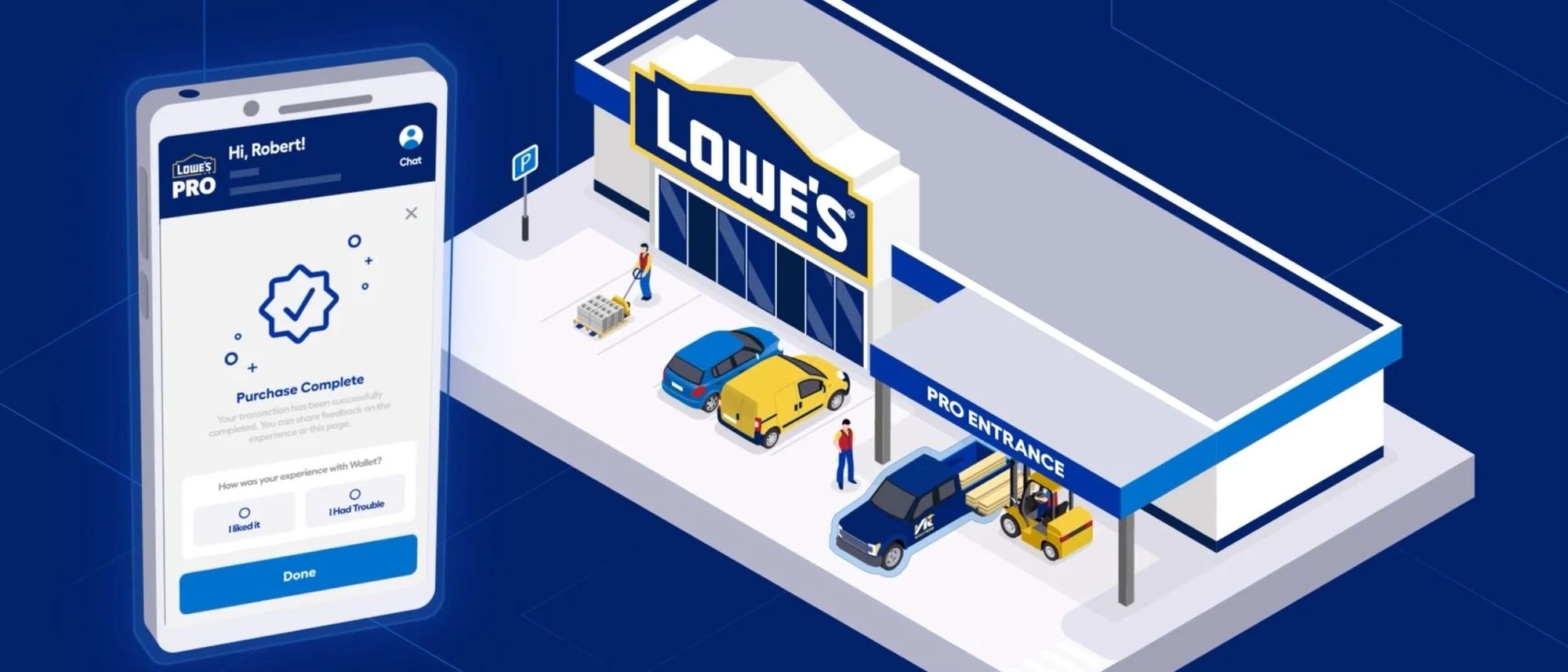
Because it shows the app and the place the app gets used in the same frame. An isometric view looks down on a scene at an angle, with no vanishing point, so a whole job site or a whole store fits on screen at once and stays readable.

For a rewards program that lives on a phone, that matters. A screen recording on its own shows buttons. A screen beside the store counter, the truck being loaded or the house going up shows what the buttons are for. Every film puts the Lowe’s Pro app next to the real-world moment it changes, so the benefit lands as a situation a contractor recognizes rather than a feature.
The style was also built on Lowe’s own brand identity: its navy, blue and yellow, and its logo. Clear messaging came first, with enough movement and play in the animation to keep someone watching who did not plan to. If you are weighing styles for your own project, six types of animation sets out the main options and what each one is good at.
How do you keep six films consistent?
You design the world once and build every film inside it. The series started from a styleframe, a single finished-looking frame that sets the look before anything moves. Once that frame is approved, the store, the job site, the trucks, the people and the phone become a set of assets that every film draws on.
That is visible in the finished films. The same pro desk, the same building under construction and the same phone appear from film to film. A viewer who watches two of them knows straight away they belong together, and a viewer who only ever sees one still gets a complete explanation.
It also changes the economics. In 2D animation much of the cost sits in design, because every character, prop and background has to be drawn before a frame moves. On a series that design work is shared, so each film after the first is drawing on a world that already exists. We explain where that cost sits in motion graphics, 2D and 3D: the differences that matter to your budget.
What should you decide before commissioning an animated series?
Four things, and all of them before anyone animates a frame.
Which pieces are separate. List the benefits, features or steps, and decide which deserve a film of their own. That list is the series. Get agreement on it early, because adding a film late is cheap and splitting a finished film is not.
Where each film will live. A film that sits on a product page, one sent by a sales rep and one running in paid social can share a world and still need different lengths and formats.
Who approves the world. On a series the styleframe carries more weight than on a single film, because every later film inherits it. Put it in front of the people who have final say, not only the day-to-day team.
What the budget covers. Our animation projects run from around $15,000 to $100,000 and up, depending on style, length and how much has to be built from scratch. Treat that as a range, not a price list. A series can land anywhere in it, and the honest way to find where is to bring a number to the first conversation rather than wait for a quote. How to brief an animation studio covers the rest of what to bring.
What does a series give a marketing team afterwards?
Coverage. Each film stands alone wherever one benefit needs explaining, and together they cover the whole program. That makes the work useful long after launch: in onboarding, at the counter, in a sales follow-up, or as the answer to a single question a customer keeps asking.
It is also why so much of our animation work is built as a series rather than a single piece. When an offer has several parts, one film per part is usually clearer for the viewer and more useful for the team that has to put it in front of them.
Lowe’s is one of several North Carolina brands we have made work for. Our guide to video production in North Carolina covers how we work across the state, from animation to live shoots.
In summary
- Lowe’s needed its MVP Pro Rewards program explained to professional contractors, an audience with little patience for marketing.
- We broke the program apart into six short animated films, one benefit each, so each could run on its own wherever it was needed.
- An isometric style built on Lowe’s brand identity put the Lowe’s Pro app next to the real-world moment each benefit changes.
- Designing one world from a styleframe kept the six films consistent and shared the design cost across the series.
- Before commissioning a series, agree which pieces get their own film, where each will live, who approves the look and what the budget is.


