

The launch film we made for InVue’s OnePOD Max won Silver in Craft: 3D/CG Animation at the 2026 Telly Awards. Craft categories judge the execution itself: the modeling, the materials, the lighting and the movement, not just the idea behind them.
The Tellys have honored video and television since 1979 and draw more than 13,000 entries a year from every US state and six continents. Work is reviewed by the Telly Awards Judging Council, a body of more than 250 executives from networks, agencies, production companies and streaming platforms. Silver is the middle of three tiers.
It is our fourth Telly. Our What If? spot for Carnegie Mellon won Silver and a People’s Telly Silver in 2024.
The credits on the winner page are Adam Sewell, Executive Producer; Joshua Hieber, Director; Peter Godshall, Lead Animator; and Taylor Topper, Marketing Director at InVue. Here is how the film was built.
The problem: a product whose best parts are hidden
OnePOD Max is a retail security display. It holds phones and tablets on the shop floor so customers can pick them up, and it keeps them from walking out of the store. Its real strengths are inside the housing: motorized arms, speed nut mounting, and integration with InVue’s OneKEY system, which unlocks a device from a phone.
None of that photographs well. A camera sees a neat stand with a device on it. The film had to explain the engineering to three very different audiences at once: retail managers, security professionals, and the shoppers walking past the display. It also had to work globally, so on-screen text was kept to a minimum to travel across languages.
This is the classic case for animation, and the same problem we wrote about in selling a product nobody can see. When the value is inside the box, the job is to make an invisible argument visible.
Built from InVue’s engineering files
The first request in the first meeting was for CAD data: InVue’s engineering files in STEP format, including the locking mechanism. Joshua went to InVue’s office the next morning to handle the product, study how it moved, and photograph the frame we wanted the film to end on, so the 3D scene could be matched to the real thing.
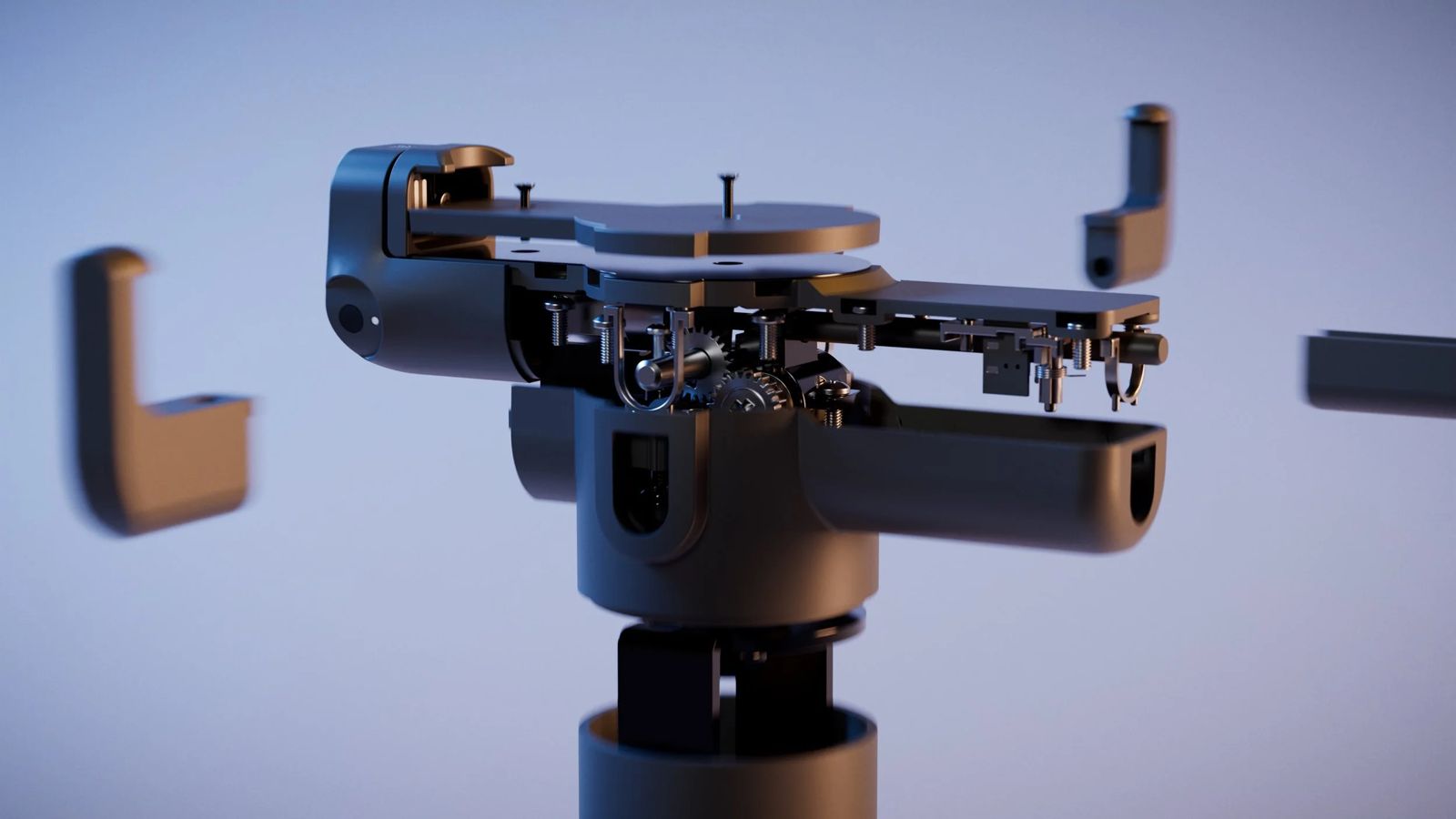
Building from engineering data is what makes a technical animation credible. The arms open on the real geometry. The mount sits on a table or a wall, both of which InVue’s customers use, because the files said exactly how. And it lets the camera go anywhere: through the housing, into the gears, along the path of the lock. That accuracy is invisible when it is right and obvious when it is wrong, especially to an audience of security professionals.

A story arc, not a feature list
The film runs on a concept-to-reality arc in four movements: abstract power, precision engineering, versatile function, and real-world application. It opens on points of light that assemble into a 3D InVue microchip, the brain of the system. From there the camera moves into the mechanism, out to the product in use with the OneKEY app unlocking a device, and finally onto the retail floor.
That structure did the explaining that a voiceover usually does. Each feature arrives as a consequence of the one before it, so the viewer follows a single thread rather than a list. We cover why that approach saves time and money in how to brief an animation studio, which uses this project as one of its examples.
Light as the storyteller
InVue’s products are white and gray, with a gold accent the brand was leaning into during a refresh. We made warm amber light the film’s language. It traces the circuitry, runs along the gears, and marks every moment of action: a button press, a lock releasing, a device charging.
That gave the film one consistent way to direct the eye. In a product that is mostly neutral materials, the light tells the viewer where to look and what just happened, without a word on screen. It also kept the film inside InVue’s palette rather than inventing a new one.
The details that win a craft award
Most of the craft was in the revision rounds. Working through the cut with Taylor and InVue’s industrial design team, we:
- slowed the transition between the app and the device so viewers could connect the tap to the result
- made the button press emit light, so the unlock reads instantly
- added a charging effect as the phone slots in
- flattened the app screens to match InVue’s real interface
- updated the logo for the brand refresh
- gave the sound design more weight at the key moments
None of those notes changes the story. All of them change how clearly it lands. That last stretch of refinement is where a technical animation stops looking like a render and starts reading like a film, and it is exactly what a craft category rewards.
One build, every channel
The :60 hero film was never the only deliverable. The same 3D build produced cutdowns for Instagram Reels and LinkedIn, sales enablement pieces, and trade show content. Building the asset once, accurately, is what makes that possible without starting over for each format.
The response matched the craft. The campaign has passed 1.3 million views, and the full story, with InVue’s own account of it, is on the OnePOD Max project page. The same film also won a People’s Telly, voted by the public, which we cover in why viewers voted for a retail security film.
What it means if you are launching something technical
Start with the engineering, not the mood board. Give the studio the real files, the real product and the real constraints, and decide early what the audience must understand by the end. The visual language follows from that. If you are weighing it up, our animation production page explains how we work, and the differences between motion graphics, 2D and 3D covers what each approach costs.
In summary
- InVue’s OnePOD Max launch film won Silver in Craft: 3D/CG Animation at the 2026 Telly Awards, judged by an industry council of more than 250 executives.
- The product’s strengths are hidden inside the housing, which made 3D animation the right tool to show them.
- The film was built from InVue’s engineering files, so the camera could go inside the mechanism with complete accuracy.
- A four-part story arc and a warm light language did the explaining, with minimal text so the film travels globally.
- The craft came from the revision rounds: timing, visible button presses, charging cues, accurate app screens and sound.


